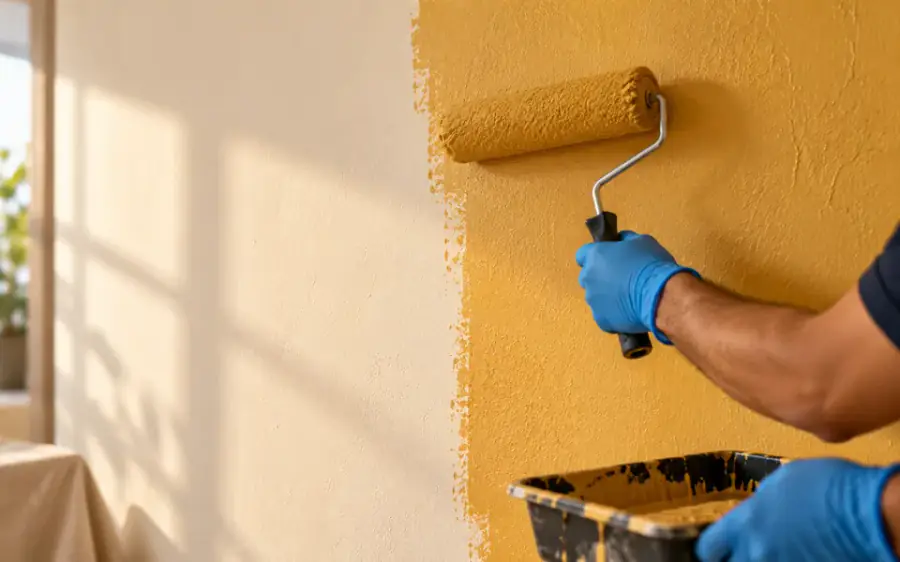

Colour is where most repaint regret comes from, and almost none of it is the painter's fault. A 2-inch chip under showroom lighting tells you very little about how 200 square feet of the same paint will behave in your living room at 6pm.
Why chips mislead
- Scale intensifies colour. A shade goes roughly two steps stronger once it covers a whole wall.
- Showroom lighting is neutral and bright. Your rooms are not.
- Chips are viewed flat and isolated, never next to your floor, furniture and curtains.
- A gloss or satin finish reads lighter than matt in the same shade, because it reflects more light.
What NCR light does
North-facing rooms get cool, indirect light that pushes greys towards blue and can make a soft green look cold. South and west-facing rooms get strong warm light for much of the year, which amplifies yellows and can make a warm beige look distinctly orange by late afternoon.
A test method that works
- 1Shortlist three shades, not ten. More than three and comparison becomes impossible.
- 2Get sample patches painted directly on the wall, at least two feet square.
- 3Put them on more than one wall in the room — light differs across a single room.
- 4Leave them for a full day and look in morning, afternoon and artificial evening light.
- 5Judge them next to your flooring and your largest piece of furniture, not against bare white.
Patches painted on paper and taped to the wall are better than nothing, but the paper edge and its slight sheen distort what you see. Paint directly on the wall where you can.
Pairings that reliably work
- Warm ochre or mustard against a cool indigo — high contrast that stays comfortable.
- A muted sage with warm wood tones — quiet, and forgiving in low light.
- Terracotta with off-white and brass — warm without becoming heavy.
- A deep single-wall colour with three neutral walls, when you want drama without a dark room.
Want this priced for your own home?
We measure on site, inspect the surfaces and give you a fixed written quote — free, and with no obligation to book.